Summary
In late June 2026, temperatures at hundreds of Farmdesk farms peaked above 35°C for three consecutive days. At that intensity, heat stress manifests differently than during a typical heat wave. Milk production dropped more sharply, the fat content initially rose instead of falling, and the urea content climbed, only to plummet within a few days. This combination points to fat mobilization and muscle breakdown, not to a typical decline in feed intake.
We also explain the best ways to handle this: from rumen buffers to an adjusted energy and vitamin intake.
Behind the scenes, Farmdesk uses the Temperature Humidity Index (THI), which combines temperature and humidity into a single measure of heat stress. For clarity, we will refer to temperature in °C in this article.
The familiar pattern: moderate heat stress in late May
In the Low Countries, heat stress used to occur at most a few times a year, and even then it was usually limited to a few days with temperatures just above thirty degrees Celsius. We are very familiar with the pattern associated with this moderate heat stress: milk yield decreases, fat content decreases as well, and protein content follows with a short delay.
The explanation lies in the rumen. Cows maintain the pH of their rumen with bicarbonate that enters via saliva during rumination, and the body produces that bicarbonate itself using CO2 as a building block. As soon as a cow starts panting to dissipate heat, she loses CO2 and bicarbonate production decreases. Less bicarbonate in the saliva means less rumen buffering, and an acidifying rumen inhibits the acetic acid-producing bacteria, which are the basis of milk fat. A little later, this acidification also suppresses microbial protein production, and together with a lower glucogenic energy intake due to reduced feed intake, this also puts pressure on milk protein synthesis. The reduced feed intake itself is due to the fact that cows can no longer dissipate the heat released during the digestion of their ration: they eat less to avoid generating additional body heat.
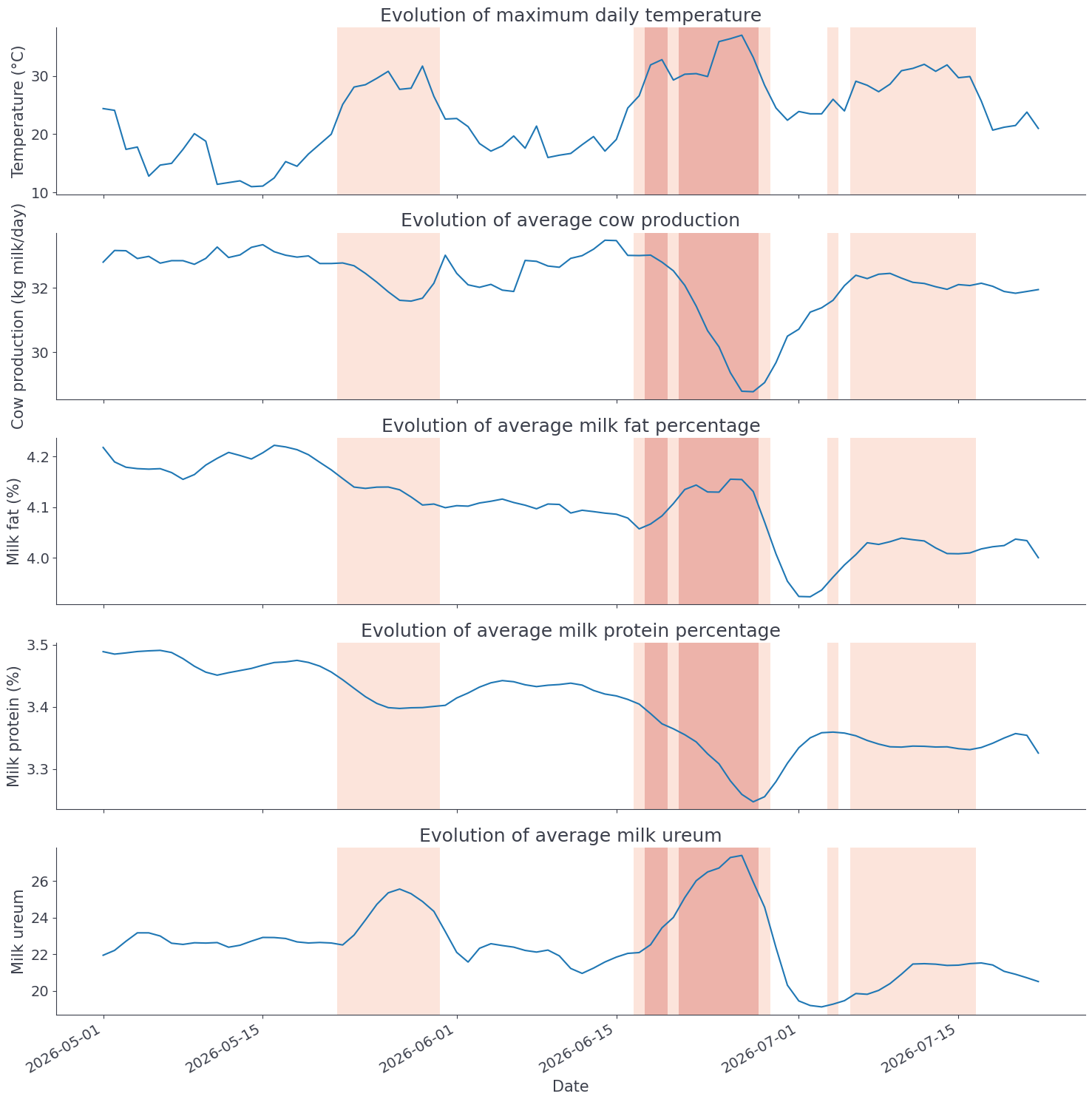
We clearly observed this pattern on our farms during the first heat wave in late May 2026, when temperatures rose to 28–31°C for several days (figure, light pink band). Milk production dropped by more than 1 kg per cow per day, the fat content continued its downward trend, and the urea content rose to just over 25.5 mg/100g. This is unfortunate but familiar, and can largely be mitigated with rumen buffers and cooling measures.
Late June 2026: when the temperature rises above 33°C
The end of June 2026 was different. From June 24 through 27, temperatures on our farms exceeded 33°C, with little cooling at night (figure, dark red band). In the barn and out in the pasture, the effects were immediately visible: cows were panting more heavily, eating less, and there were isolated deaths due to overheating. What the dairy farmers then observed at the milking robot or in the tanker did not match the expected pattern: the fat content initially rose instead of falling, and the urea content spiked completely independently of the feed ration.
What the figures on hundreds of companies show
A retrospective (a posteriori) analysis of hundreds of high-producing Farmdesk farms in Flanders and the Netherlands confirms this picture (Figure 1). Between June 18 and 27, average production dropped from over 33 kg of milk to a low of less than 29 kg of milk per cow per day—a decline of more than 4 kg of milk, which was both faster and more severe than during the May heat wave. The fat content behaved in the opposite way to what we typically see during moderate heat stress: it rose from 4.06% to a peak of 4.15% on June 25. The protein content continued to decline steadily during the same period, from 3.38% to a low of 3.24% on June 27. The urea content rose from 22.5 mg/100g to nearly 27.4 mg/100g, only to plummet within a few days by July 3 to 19.1 mg/100g—the exact opposite of the peak.
As soon as the heat wave ended on June 28, production and fat content began to recover steadily. Protein and urea levels took longer to recover and did not return to their pre-heat wave levels until mid-July.
The Explanation: From Fat Mobilization to Liver Strain
That combination—rising fat, falling protein, sharply rising urea, and all of this alongside a significant drop in production—does not indicate a rumen problem alone, but rather a cow that is drawing on her body reserves. With such low feed intake, high-producing cows can no longer meet the energy demands of their milk production through feed alone. They mobilize fat from their reserves to provide energy, and this is the metabolic picture of a negative energy balance, with chronic milk fever as the well-known outcome: rising fat content because mobilized fat finds its way into the milk, and falling protein content because the ribosomes in the mammary gland cells can no longer efficiently synthesize milk protein when there is an energy deficit.
The sharp rise in urea levels indicates the next stage: if fat breakdown is insufficient, the cow’s body also breaks down muscle tissue. The proteins and amino acids from this tissue then serve as a source of energy. What remains after these amino acids are metabolized is converted by the liver into urea, which is excreted in the urine via the kidneys and also appears in the milk. This places a double burden on the liver: it is already processing all the ketones from fat breakdown, and now has to handle urea production on top of that.
What helps: buffers, energy, and protective vitamins
Rumen buffers and cooling remain the first line of defense, both during moderate and extreme heat stress. During extreme heat stress, energy supply deserves extra attention. Sufficient glucogenic energy—supplemented with propylene glycol or glycerol if necessary—provides energy with minimal rumen load. Fat supply also deserves attention, but not just any fat: a splash of soybean oil puts just a little extra strain on the rumen. A better option is fat that is released only after passing through the rumen, such as cold-pressed sunflower or canola meal, whole sunflower seeds, or—more readily available through livestock feed suppliers—stable palm fat.
Because the liver is under heavy strain during this phase, liver-protective B vitamins—niacin and stable choline—are beneficial, possibly supplemented with stable methionine as a methyl donor for the antioxidant response, along with vitamin E and selenium. Cows produce vitamin C on their own, but that production is compromised under severe heat stress. Extra vitamin C then conserves vitamin E and selenium stores and helps the cow withstand the oxidative stress caused by extreme heat.
"Heat stress comes in varying degrees, and its effects on cows differ depending on the intensity. At Farmdesk Climate, we track the climate footprint of milk; this summer taught us that this same climate monitoring also provides early warnings about how the heat itself affects cows."
Wim Govaerts