Summer is coming to an end, and I've finished my vacation book. It was The Wizard and the Prophet (2018) by American science journalist Charles C. Mann. It turned out to be one of those books that stays with you long after you’ve turned the last page, not because it offers clear answers, but because it provides a broader framework for discussing sustainability without falling into opposing camps.
Is humanity doomed to destroy itself?
Place a bacterium in a Petri dish containing enough culture medium. It multiplies exponentially until the dish is full. Then the nutrients run out, waste products accumulate, and the population collapses. Every biologist is familiar with that curve.
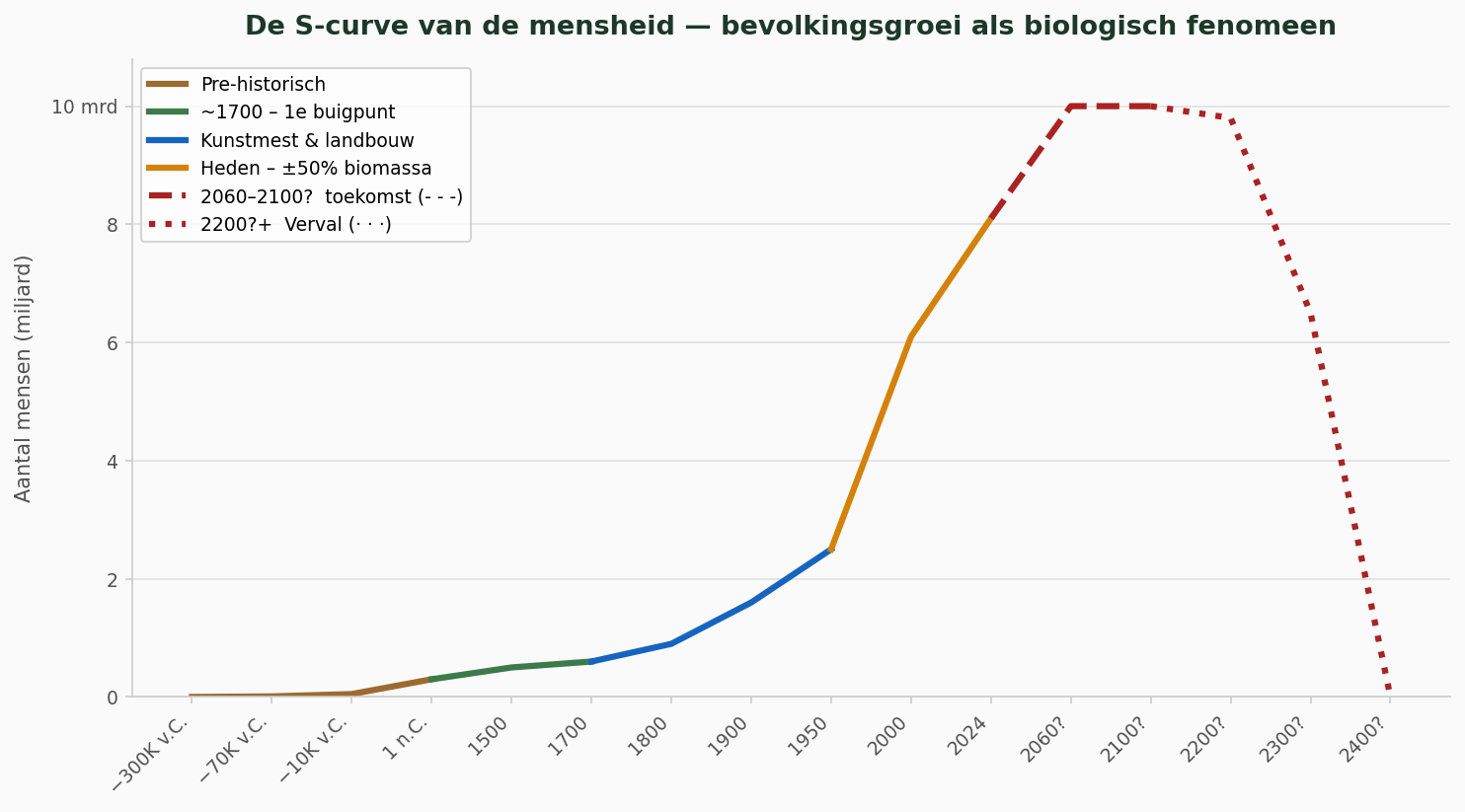
The question Mann poses is an uncomfortable one: does the same principle apply to us? Biologist Lynn Margulis put it bluntly: “Bacteria and humans are alike: we’re both runaway animals.” From the first Homo sapiens up until today, our population growth has indeed followed a classic S-curve. A slow start, an explosive rise, and then what?
Can the Earth provide a good life for ten billion people? That is the question the entire book revolves around. The author’s own TED Talk from 2018 is highly recommended: youtu.be/rmfzwwrCrrU.
Two men, two answers
Mann structures his book around two real historical figures who could hardly have been more different from one another.
William Vogt (1902–1968) was an ecologist and ornithologist. His defining moment came in Peru, where he studied guano bird colonies. He observed how the population exploded in good years and collapsed when the anchovies were absent. For him, carrying capacity was not an abstract concept but something he had seen at work with his own eyes. In 1948, he published Road to Survival, one of the first radical calls to limit consumption and population growth. His conclusion: the Earth has limits, and we must learn to live within them.
Norman Borlaug (1914–2009) was an agronomist and plant breeder. His defining moment came in Mexico, in the fight against the rust fungus that was destroying wheat crops. For years, he manually crossed and selected thousands of wheat lines until he had varieties that were both resistant and yielded much higher harvests. As the father of the Green Revolution, he is estimated to have saved more than a billion people from famine. His conclusion: boundaries are meant to be broken, through science and innovation.
Mann calls them the Prophet and the Sorcerer. That tension runs through every major challenge facing humanity today.
Four elements, four challenges
Mann structures his analysis around four fundamental challenges, framed as Plato's four classical elements.
Earth: food. It all began with Carl Sprengel, who discovered in 1828 that plants grow by absorbing nutrients, and with Justus von Liebig, who deduced the logic behind synthetic fertilizers from that discovery. The Haber-Bosch process (1913) made nitrogen from the air available on an industrial scale. Without that synthetic nitrogen, it would be impossible to feed half of the world’s current population. But along with the benefits came the costs: nitrate leaching, dead zones in coastal waters, and soil degradation. This is precisely the criticism leveled by Vogt.
Water. Only 2.5% of all the water on Earth is fresh water, two-thirds of which is locked up in ice caps and glaciers. Much of the remainder is found in inaccessible groundwater. In practice, approximately 0.1% remains directly available. Agriculture accounts for 70% of that usage. Israel is the textbook example of the “Wizards’ Approach”: a national water transport system, desalination plants such as Sorek, and drip irrigation have transformed a water-scarce country into a net food exporter.
Fire: energy. Coal was already in use around 3400 B.C., but it wasn’t until James Watt’s steam engine that it became an industrial game-changer. The Industrial Revolution is not just about emissions: extreme poverty fell from affecting more than 80% of the world’s population in 1820 to less than 10% today. That same revolution caused CO₂ concentrations to rise from 280 ppm to more than 425 ppm.
Air: climate. The greenhouse effect is not a matter of scientific controversy. Solar energy heats the ground and water, which radiate infrared back into the atmosphere, and greenhouse gases trap a portion of that radiation. Water vapor does most of the work, but leaves gaps in the absorption spectrum. CO₂ fills precisely those gaps, which is why a difference of a few hundred ppm matters. The New York Times reported on this as early as 1959. On June 23, 1988, NASA scientist James Hansen testified before the U.S. Senate that global warming had begun in a measurable way.
Where the Wizard and the Prophet Begin to Meet
The contrast is most striking when it comes to climate issues. One example, and certainly not the only one, makes it clear why neither one alone is sufficient.
The Wizard looks at Mount Pinatubo. When that volcano erupted in 1991, it spewed 20 million metric tons of SO₂ into the stratosphere, resulting in a two-year global temperature drop of 0.5°C. That triggered research into Stratospheric Aerosol Injection: Sulfur dioxide is, per molecule, about 50,000 times more effective at lowering temperatures than CO₂ is at warming them, meaning that, theoretically, 100 flights per day would suffice, compared to the 100,000 that already take place.
The Prophet envisions reforestation on a continental scale: covering the Sahara and the Australian outback, which together are larger than Europe, with forest. A return to something resembling the Carboniferous Period. Not a technological Band-Aid, but a restoration of the carbon cycle itself.
But here’s the thing: deserts are dry. And that’s where the Wizard comes in, with desalination, water transport, and drip irrigation. Without that technology, the Prophet’s vision remains a dream. Without the Prophet’s systemic perspective, no one would ever come up with the idea.
Back to the S-curve
That brings us to the opening question. Are we an ordinary biological species, or not?
Scenario A: We're following the logic of the petri dish. A plateau around 10 billion, then a collapse. Vogt would say that this is the baseline scenario, and that anything we do to flatten the curve only makes the fall worse.
Scenario B: We are deliberately adjusting our own growth and stabilizing it at around 10 billion. That would be something fundamentally unnatural. No other species does that.
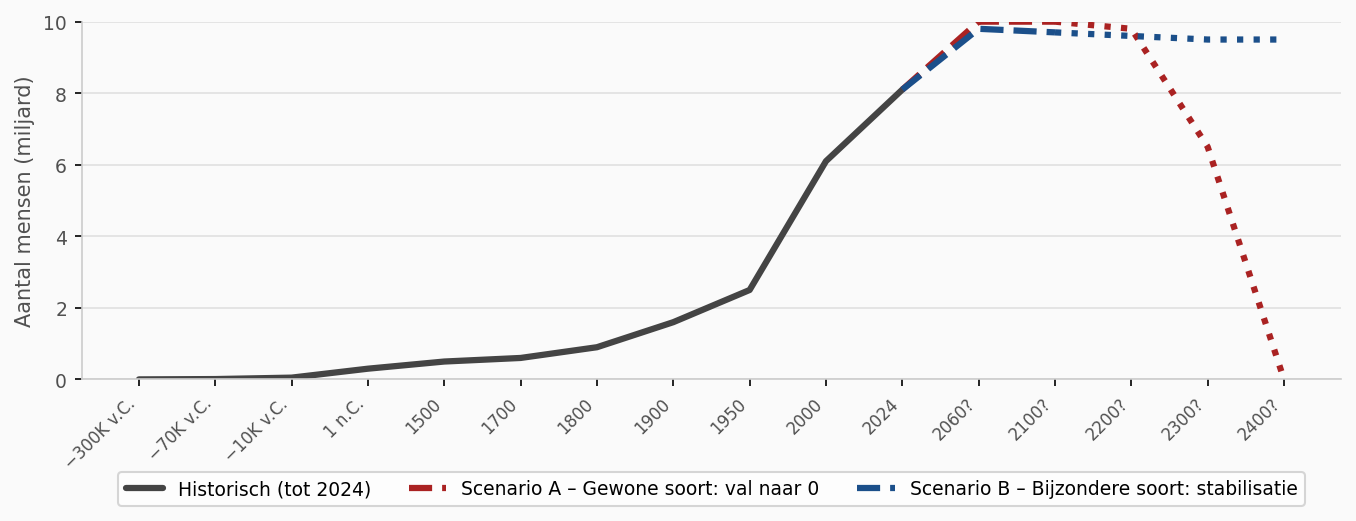
That is exactly where the Wizard and the Prophet meet. Scenario B requires both technological capability and a willingness to stay within certain limits.
"Choosing between the Wizard and the Prophet isn't quite the solution. The real challenge is that they have to work together."
Jef Aernouts