Introduction
In addition to developing a Climate tool for large and small ruminants producing milk/meat and for the potato sector, Farmdesk is now launching a module for the pig farm.
In this article we show a first calculation on a typical pig farm. With these figures we do not want to claim averages or set examples for the pig industry. However, we would like to calculate an example farm with two additional scenarios to show which things, if any, could have a positive or negative effect.
Case farm
The sample farm is a closed farm with 250 sows and finishing. The production rate for the sows is ±31 weaned piglets per sow per year.
We assume a failure rate of 4%, a growth rate of 850 grams per day of finishing pigs and a feed conversion rate of 2.75 in the finishing phase.
The ration for the various departments consists percentage-wise of:
| Feed | Sows | Piglets | Fattening |
|---|---|---|---|
|
Barley |
25% |
20% |
25% |
|
Wheat |
25% |
20% |
25% |
|
CCM |
15% |
20% |
20% |
|
Bran |
10% |
5% |
5% |
|
Lucerne |
5% |
- |
- |
|
Soybean meal |
15% |
15% |
20% |
|
Sunflower Scrap |
5% |
5% |
5% |
|
Wei |
- |
10% |
- |
|
Potato Protein |
- |
5% |
- |
The farm has 30 acres of land, of which 20 acres are cultivated with grain corn to feed as ccm and additionally 10 acres of barley for home consumption by the pigs.
Results and discussion
Case farm
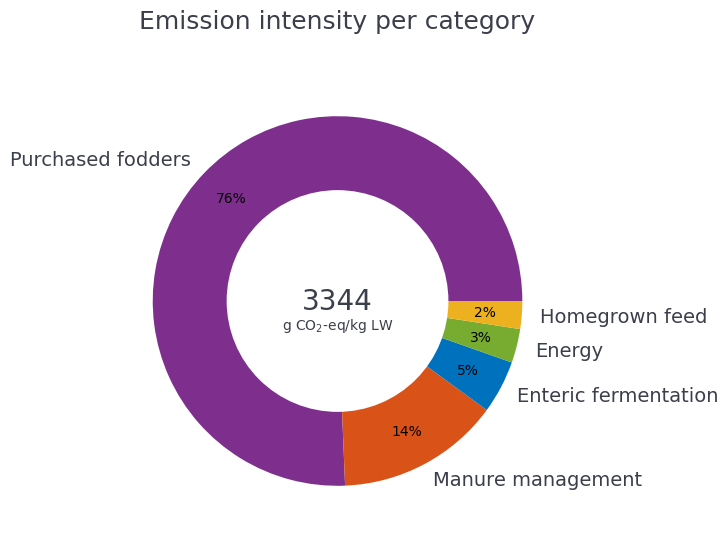
The example farm’s carbon footprint amounts to 3.34 kg of CO2-equivalent per kg of live weight leaving the farm. Purchased feed accounts for 76% of emissions, followed by manure management at 14%, enteric fermentation at 5%, energy at 3%, and farm-grown feed at 2%.
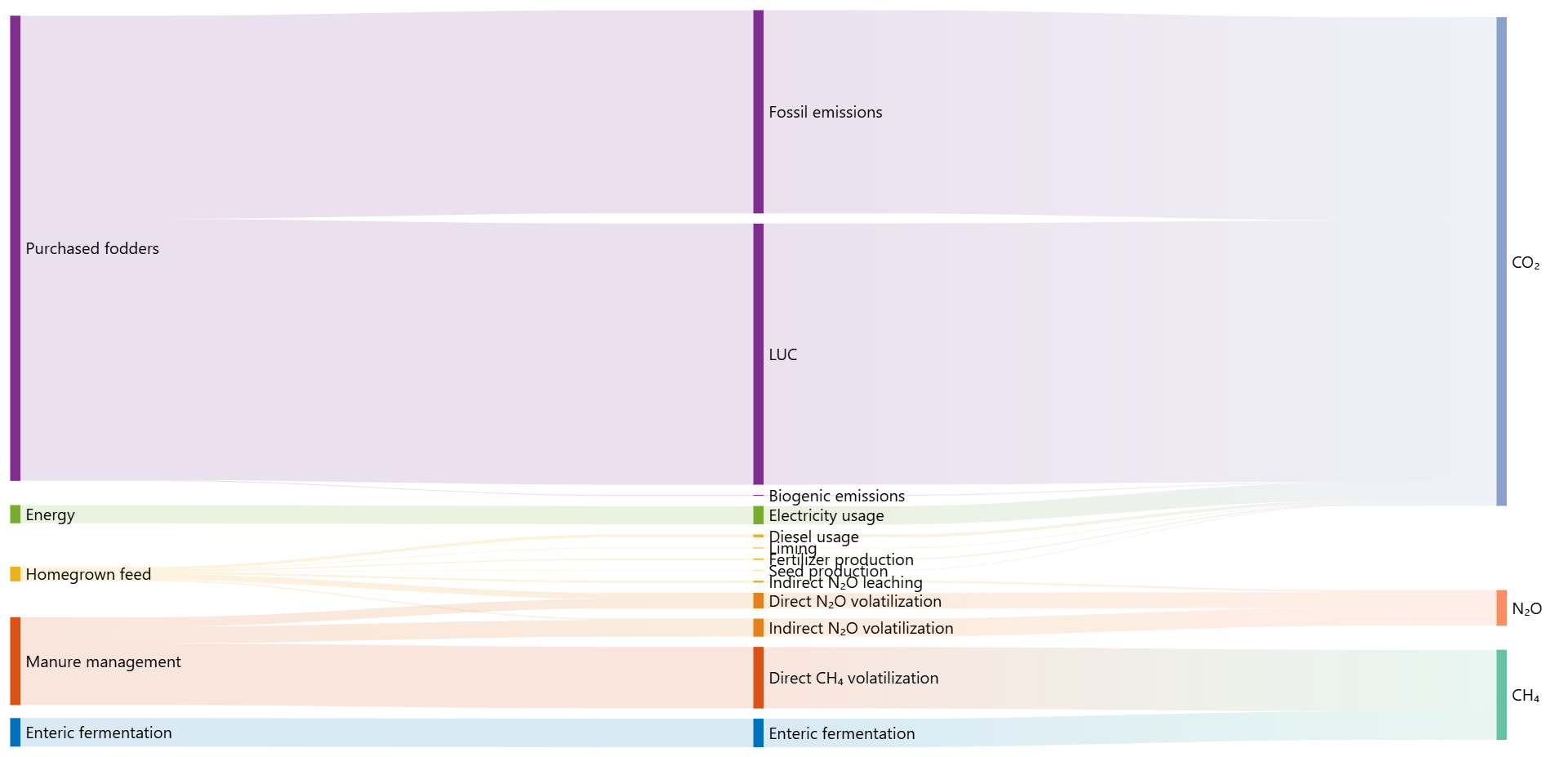
In the flowchart below, emission sources are linked to the various greenhouse gases via subcategories. This presents a significantly different picture than for ruminants: whereas methane is the main player for ruminants (for more details, see our dairy cattle and beef cattle-publications), CO2 makes the largest contribution in pig farming. Note also the significant contribution from land-use change, where emissions result from deforestation for the production of animal feed.
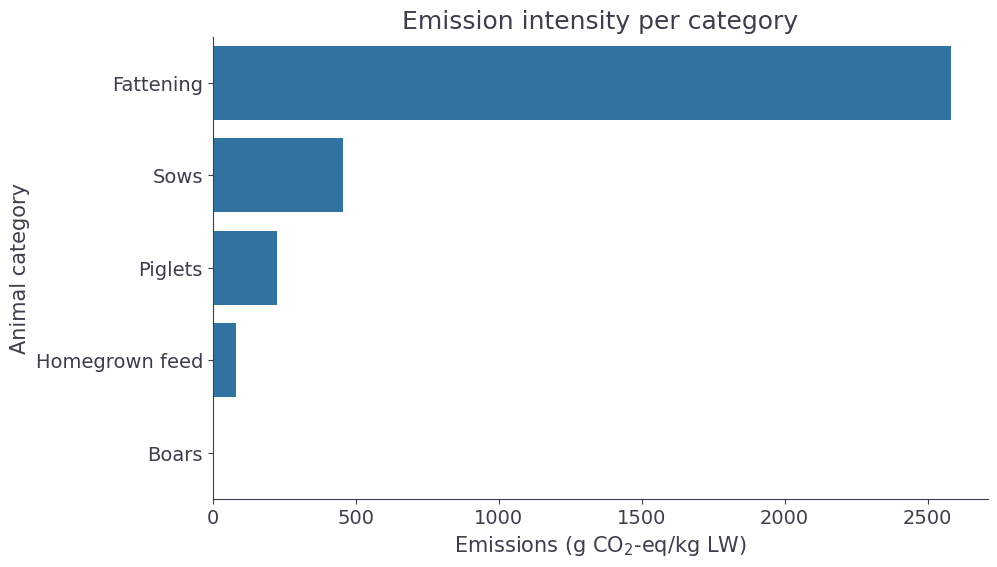
Not only do emissions from pigs in the finishing phase count, but emissions from sows, weaners, boars, and any emissions from the production of on-farm feed are also calculated and allocated across the total live weight leaving the farm. The graph below illustrates the relative contribution of these different categories. It is clear that the finishing phase has the greatest impact.
Alternative scenarios
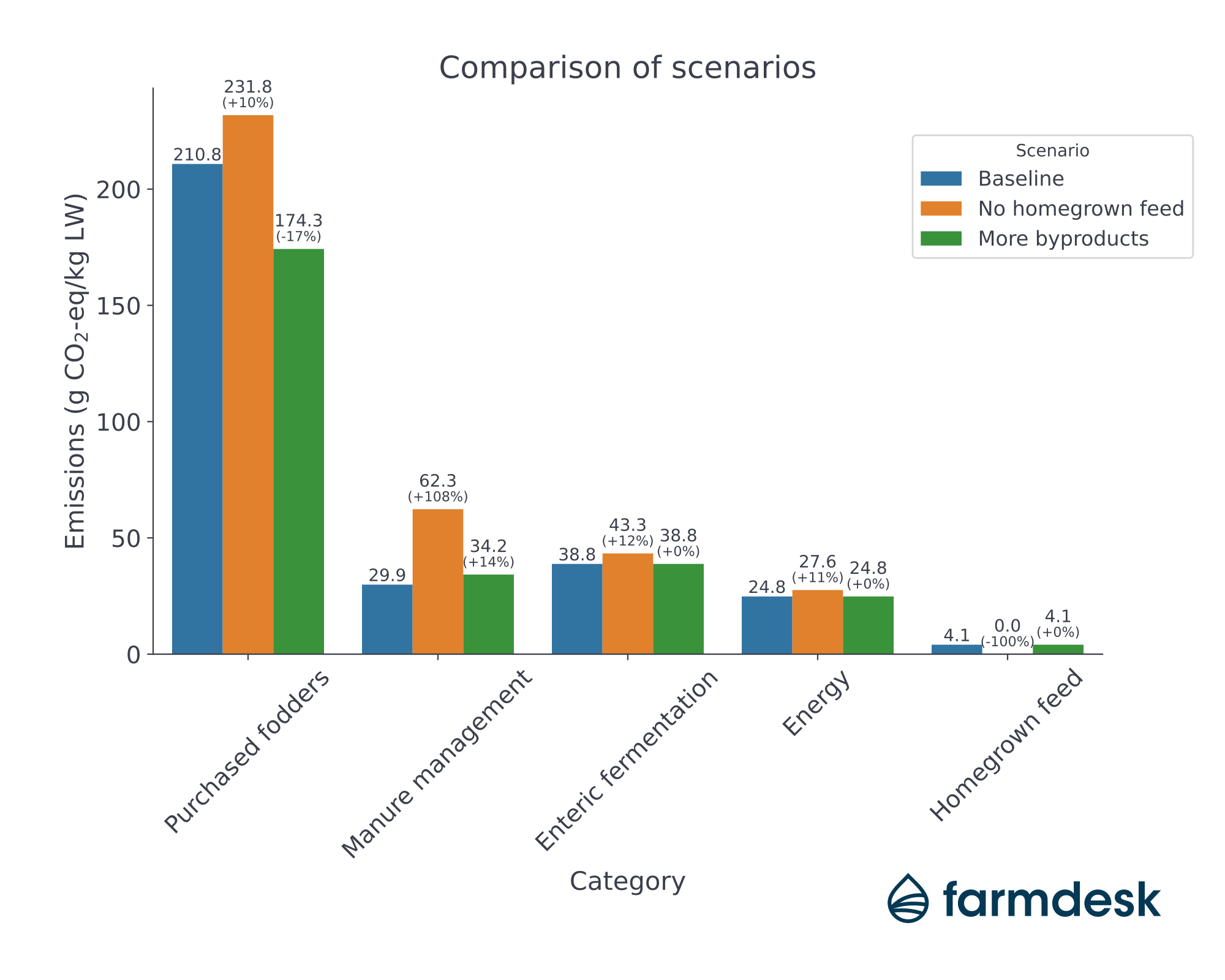
In addition to the example farm, the carbon footprint of a farm without its own crops and with lower technical performance was also calculated for comparison: a 5% lower production rate, 10% lower growth, and 5% higher feed intake. For such a farm, we naturally arrive at a higher footprint of 4.06 kg CO2-eq/kg LG, an increase of 21% compared to the example farm.
However, if we assume a technical performance similar to that of the example company, supplemented by a partial substitution of grains and soybean meal with wet byproducts (corn gluten and brewers’ grains), without compromising the dietary balance, we arrive, as expected, at a lower carbon footprint of 2.97 kg CO2 -eq/kg LG, a decrease of 11% compared to the example farm.
Conclusion
This article presents the expansion of Farmdesk Climate into the swine industry through a case study. The example farm has a carbon footprint of 3.34 kg CO2-equivalent per kilogram of live weight.
Alternative scenarios were also calculated, showing that a decrease in 11% is possible with higher technical performance, the use of home-grown feed and the substitution of concentrate feed with wet by-products such as by-products from the human food industry.